Wednesday, August 28, 2019

EMMYS 1959: The Jack Benny Program (season 9)

NETWORK: CBS
SPONSOR: Lucky Strike

The popular American comic entertainer Jack Benny was a staple of radio for decades before supplementing his radio program with a television version in the 1950s, bringing along his regular recurring cast and announcer Don Wilson. A sort of comedy/variety series, it was finally awarded Best Comedy Series for its ninth season, as well as a win for writing for the episode with Ernie Kovacs.

The Jack Benny Program on television is a strange entity in that for years it was not a regular series. Jack had an infrequent schedule due to his many other commitments, and in the early days there were only a few shows produced. By the late 1950s, the series was aired every other week, alternating time slots with *Bachelor Father* or some other series. Thus, there were only 15 episodes this season in an era where most half-hour series regularly ran twice that. It must have been strange to only get to see the show every other week. But I suppose for regular radio listeners, the change wouldn't be so bad, and there were only three television networks anyway.

Also like most television programs of the day, the show was sponsored by big tobacco, this time Lucky Strike. So there were of course commercials and jingles for the sponsor. Jack often refers to it as "The Lucky Strike Program" on air. There was an episode where Jack was trying to shmooze his sponsors because it was time to renew the contract and he feared they would drop him. The episode ends with Benny signed for another year, though in reality sponsorship would change the following year to Lux soap.

Unfortunately, as with some previous series in this project, it was very difficult to easily procure episodes and I could not obtain a full season to watch. This is one of those series where select episodes circulate or segments or sketches are excerpted, but finding full episodes is difficult, and from a specific year even trickier. Ultimately, I was only able to view 6 of the 15 episodes to review here.

Due to the minimal sampling, it was difficult to get a handle on what exactly the format of the show was. It follows some of the variety show template, but sometimes has sitcom elements thrown in. Of the episodes I saw, it wasn't always clear that there was a consistent format at all. To sum it up, I'd say the show was Jack Benny, and sought to entertain you however he wanted that week. There was often (but not always) the general set-up of a monologue in front of a curtain, a celebrity guest star, some comedy sketches and possibly a musical performance. Sometimes the whole show was live, but sometimes sketches were filmed segments. For one show, Benny and his cast put on a parody of the movie Gaslight (called "Autolight"). But then at other times episodes would play out as kind of meta-narratives taking a sitcom-style approach to the backstage world of Jack Benny before or after the show. One such episode is all framed as the rehearsal day before broadcast. Jack is worked up over interactions he's had with a strange person, and Oscar Levant advises he sees someone about it. The person in question is played by character actor Frank Nelson, who you might immediately recognize if you heard him say, "Yeeees?" This is one of those voices and personas that if you've seen enough comedy from this era, or comedy that references it, is immediately recognizable. And it's still funny.

I was bummed that I was unable to find the episode where Phil Harris guested. Harris was Benny's former band leader in the early radio days, but to many modern audiences he is more familiar is a voice in many Disney films of the 1960s and '70s, notably Baloo in The Jungle Book.

It's a shame I was unable to see more of this season and really get more of a feel for Benny's comedy, but I liked the smattering that I saw, and it was interesting to see the award get back to a more variety show styled comedy series after being dominated by the sitcom. CBS has been sweeping the category year after year! Will it continue? The Jack Benny Program would win a second Emmy in its 11th season, but before that we come to the 1960 Emmys when things were weird.

FAVORITE EPISODE: Jack Goes to the Doctor
UP NEXT: The Art Carney Special (that is, if I can find it)

Monday, August 19, 2019

EMMYS 1958: The Phil Silvers Show (season 3)

NETWORK: CBS

The Emmys were strange in the mid-1950s. I neglected to get into this in the last post, but for the 1957 awards, series were not split into category by comedy or drama, but by running time. There were nominees for half-hour programs, which were mainly comedies, and The Phil Silvers Show won that category. There was a separate category for hour-long programs, which also went to a comedy series, Caesar's Hour, and a category for best single program, which was mostly episodes of anthology drama shows. For this reason, it's weird from a historical perspective knowing how to categorize these wins. Perhaps I should go back and review Caesar's Hour as well.

For the 10th annual awards the following year, there was again a designated Comedy Series category, and The Phil Silvers Show won for the third year in a row. And despite it being long into the series run, the third year is an extremely important moment in television history, though one that doesn't often get discussed. The third episode of the season was called "Hillbilly Whiz" and it was the story of a new recruit from somewhere down south who had a great pitching arm. Bilko conspires to get him scouted by the pros, and there are cameo appearances by Yogi Berra and other players of the 1957 New York Yankees. And this would be neat in itself, but from a historical perspective, the other guest star is more important. You see, that hillbilly pitcher role was the television debut of Dick Van Dyke.


Image result for dick van dyke phil silvers

Dick Van Dyke apparently made such an impression that he returned later in the season playing Bilko's cousin, also a similarly folksy drawling amiable guy. It's clear from his two appearances that he has a kind of comedic personality that lights up the screen, and he plays well off of Phil Silvers. In just a few years, CBS would give Van Dyke his own series and he would become a star.

While Van Dyke's appearances are the main highlights of season 3, they are not the only bright spots. The series has settled into a groove and it knows what stories it tells. There are continued appearances from celebrities of the day. It's funny how some celebrities remain household names and others don't. Last season was the appearance of Ed Sullivan and Bing Crosby, and that still holds today, but it's quaint watching everyone flip out over the appearance of Kay Kendall, when most modern viewers would scratch their heads and say, "Who?"

Some of the stories also start to get a little sillier.  Paparelli spends an episode in drag in order to use a vacation that he won in a contestant, not realizing it was for married couples. Doberman continues to be a source of humor, particularly in "Doberman the Crooner", where it turns out he has a gorgeous Irish tenor voice, but only when he's sick.

One issue I do have is that by season 3 Bilko is made out to be sort of a gambling genius, and this doesn't really hold with earlier depictions of the character. Yes, he consistently gets the better of guys like Ritzik or some of his men, but in the very first episode he had a gambling debt. This heightened confidence in his abilities does lead to a wonderful episode where Colonel Hall finally gets the better of Bilko by scamming him with a professional card manipulator, shattering Bilko's confidence. And that's one of the nicest things about this season, is the effort in a few episodes for Colonel Hall to no longer be just a bumbler but learn from his mistakes and he actually gets the better of Bilko several times. This is a nice reversal, and it pays off for long-time viewers. In another episode, Ritzik learns the secrets of Bilko's scams when he talks in his sleep. It's fun to see the master manipulator get one-upped every now and then.

FAVORITE EPISODES: Hillbilly Whiz, The Big Man Hunt, Bilko Talks in His Sleep, Bilko at Bay, Doberman the Crooner, The Colonel's Reunion, Bilko's Cousin

UP NEXT: The Jack Benny Program


Monday, July 8, 2019

EMMYS 1957: The Phil Silvers Show (season 2)

NETWORK: CBS

CBS continued its history of winning the Emmy when the award went to the second season of The Phil Silvers Show. Clearly, Silvers' personality and charisma as the Bilko character proved popular and still allowed for a number of stories. I did find that the series tends to go back to the well with the same three or four ideas, but the writing is so good that even a formulaic episode is still a lot of fun. It's like when a great band covers a familiar song.

One of those constant tropes is the "someone is sent to rid the platoon of gambling through the arts" story. The first season did this three or four times. But the clever way it was approached this season was fun because we'd been through the dance before so seeing someone try to outwit Bilko at it was fun. Another classic trope is the blue-blood rich looking down on the servicemen. This occurs twice in this season. It's telling that the series really takes a stand against the aristocracy, as if they are the enemy of the common man, and the highest form of common man is the American soldier. It's a reminder to the country to respect their servicemen. In a post-war era with conflicts beginning to heat up in other parts of the world, this is a nice sentiment.

The second season brings back Bilko's sometime love interest, WAC Sgt. Hogan. However, they have tweaked continuity. The series is definitely contemporary from all its references, and the year is explicitly identified in an amusing story where Bilko is audited. But Hogan was introduced to the platoon only last season, and now the series consistently says they've been dating for five years. I don't remember what the date references were last season, but I don't think there's a five year gap between. Chalk it up to new continuity. You could get away with that more often when there were fewer reruns.

We also gain a new recurring character with Sgt. Ritzik, and his catchphrase ("I knew it!"). Ritzik is a guy always trying to beat Bilko at a bet, but he's a born loser. So there's a lot of fun conflict between Ritzik and his wife over his obsession with beating Ritzik.

What remains consistent into the second year is Bilko's love for his men. He may rib them and use them, but he will preserve their dignity. Many stories continue this  thread, such as pulling scams to embarrass the blue bloods that embarrass his men, or trying his best to let Ritzik win for once.

The second season also cements the series' place in popular culture by having celebrity guest appearances. Bing Crosby turns up in one episode, and another is built around Bilko getting a spot on The Ed Sullivan Show. Sullivan actually appears in two episodes. The latter is a clever meta-story that features Phil Silvers as himself discussing last night's episode with his cast mates at dinner. He runs into Ed Sullivan and they discuss their episode, which turns into a series of sequences from previous episodes that had been cut for time. It's the kind of episode that's very ahead of its time, and a clever way to avoid doing a standard clip show. Instead of moments we'd already seen, we are treated to extended gag sequences we haven't already seen. Now, whether these were truly from the cutting room floor, I don't know. But I thought it was a smart change of pace.

Another episode that pays a nod to the times is "Rock 'n Roll Rookie" in which an Elvis stand-in named Elvin Pelvin joins the platoon. He just wants to be treated like everyone else, but Bilko tries desperately to record him singing so he can sell the record. It's fun to see the show take on Elvis, who was at his height at this time, with Jailhouse Rock releasing that year. The story also plays to all audiences by both kind of embracing the character but also having the older generation taking good-natured jabs at him.

In another nod to present-day goings on, there's a great quiz show episode where Bilko contrives to get one of the men on The $64,000 Question. A lot of TV shows have done "guy tries to cheat quiz show with secret radio" stories, and I was immediately reminded of that here. But of course there was also a real life quiz show scandal in this era, so it's funny thinking about in that context as well.

I regret that CBS started pulling some of the episodes from the online source I was using, so I was unable to watch a few of the last episodes. Still, on the whole I enjoyed the second season. While it played safe and predictable with a number of the set-ups, I found I liked certain episodes even more. The characters are coming into their own, with their own personalities and catchphrases, and some of the premises are consistently funny and remain fresh. Part of that is how Silvers continues to sell it with everything he has. So even if Bilko's running a similar scheme (getting a film made, getting a song promoted; starting a mink farm, starting a radio station) the energy and innovation continues to make it a blast to watch.

FAVORITE EPISODES: "A Mess Sergeant Can't Win", "Bilko's Tax Trouble", "Doberman's Sister", "Bilko Gets Some Sleep", "Bilko Goes to Monte Carlo", "Show Segments"
UP NEXT: The Phil Silvers Show (yet again!)

Friday, April 5, 2019

EMMYS 1956: The Phil Silvers Show (season 1)

NETWORK: CBS

For the 1955-56 season, the Emmy for Comedy Series went to the premiere season of The Phil Silvers Show. But that was not the original title. When it debuted, audiences were greeted with the announcement introducing "The Phil Silvers show 'You'll Never Get Rich'!" This is similar to other series of the time. In its initial run, I Love Lucy was always introduced as "The Lucille Ball Desi Arnaz show" before the title, as if you had to remind the audience who was in it every week. The original title of the series, You'll Never Get Rich, comes from a line from an old song:
You're in the army now
You're not behind a plow
You'll never get rich
By digging a ditch
You're in the army now!

The song is sung at various times throughout the season. While the title was certainly appropriate, it was eventually dropped and the series stuck with just highlighting its central star, becoming officially The Phil Silvers Show. I was unable to find clear information on when the original title was dropped, but it appears to have been during the first season. You might recognize the show by the name of his character, the name the series was sometimes broadcast in syndication under, Sgt. Bilko.

 Image result for phil silvers sgt bilko

The Phil Silvers Show was sponsored by Camel cigarettes, so once again all of the original cigarette ads done by the cast have been cut out of later syndication run, and the original opening replaced with an animated version. Watching all of these shows in sequence, it's no wonder America smoked so much. It seems like the entire television industry was built on the back of big tobacco.

Phil Silvers portrays a somewhat bumbling and scheming bald-headed bespectacled army sergeant named Ernest Bilko who is in charge of the motor pool at Fort Baxter in Kansas. He's a fast talker, gambler, flirt, and jovial sort always out to make a buck, often at the expense of the other men at the base. He runs betting pools among his men, has frequent card games with other sergeants, and is the thorn in the side of the base's commanding officer. When the series begins, the initial set-up is that Bilko's outfit has been doing these things because he's let things get sloppy since they were so well-trained. To shake things up and keep Bilko busy with real work, they assign him a platoon of new recruits. Bilko then spends most of the first episode trying to swindle the men out of their money so he can pay off a poker debt. The series sticks with the premise for a few episodes before returning his original platoon to him with no explanation in episode four, and maintaining that for the rest of the season.

Bilko also meets his match when Sgt. Hogan, a new female sergeant comes to the fort. She's hip to his schemes and eventually that start an on-again off-again relationship. His platoon is racially integrated; there's a black man in the group. It's nice to see that in the mid-1950s, and there was never any comment about it. He was always just another one of the guys.

It's interesting setting a series in the army during this period. America was now ten years post-World War II and settling into a comfortable civilian life. Other popular series have focused more on this renewed domesticity. But here we have a show looking at the servicemen who are still serving their country. Bilko is a veteran of the war in the Pacific, and old war stories come up every now and then throughout the series, particularly in a hilarious episode with him as a consultant for a WWII movie, and a moving episode about a reunion with his old army buddies. His friends have moved into civilian life, and he's stayed in the service. I suppose it's also worth remembering that the Korean War had only just reached its stalemate a few years ago, and America's military was still poised to fight the red menace of communism. So it's neat to get a comedy set here as a time capsule of sorts. The general tone is similar in some ways to popular wartime comedy like Stalag 17.

The Phil Silvers Show was created and primarily written by Nat Hiken, who would later go on to create Car 54, Where Are You? The writing is sharp. And while a lot of episodes might revolve around similar premises, it doesn't get stale because they shake it up enough. Sometimes Bilko's looking to con his own guys, but in the end he still looks out for them as his men, and there will be other times he coordinates them as a group to pull something on someone who has wronged them. There's enough variety to keep the laughs coming, while allowing for character moments with Bilko or some of his men.

But what elevates it is the full-bodied performance of Phil Silvers. He takes on every action with gusto and quickly becomes a big television character of the best kind, the kind that's immediately recognizable and iconic. He peppers his lines with ad-libs and really hams up the extended bits where he's schmoozing or trying to pull a fast one.

In fact, it's funny looking back on it, but the Bilko character as portrayed by Silvers was a template for later TV characters. Most people are aware that The Flintstones was essentially a parody of The Honeymooners, but I wonder how many realize that Hanna-Barbera's Top Cat was essentially a riff on Sgt. Bilko. Sure, the setting is transposed from the army to a group of cartoon alley cats, but it's essentially the same thing. Top Cat's delivery and mannerisms are in retrospect very clearly modeled after Silvers.

I had been aware of the series for a long time. It ran briefly on Nick-at-Nite when I was a kid. But I had never really sat down and watched it. Having done so, I immediately saw a comparison to one of my cultural touchstones, Saved By the Bell. It is extraordinary how much Zack Morris is really just a '90s teen version of Bilko. I am certain there's a generation who grew up on that show that has no idea the debt it owed to this classic series. If you're a fan of Saved By the Bell, I recommend seeking out some Phil Silvers episodes and seeing for yourself. The entire series has been released on DVD, and there are also a number of episodes on YouTube.

FAVORITE EPISODES: The WAC, The Centennial, The Twitch, The Reunion, Hollywood, Kids in the Trailer, The Court Martial, Bilko's Hair
UP NEXT: The Phil Silvers Show (again!)

Sunday, March 10, 2019

EMMYS 1955: Make Room For Daddy (season 2)

NETWORK: ABC


And now we unfortunately come to a bit of a snag in my grand scheme to watch every Emmy-winning season of television comedy. The next series to win the Emmy for Outstanding Situation Comedy was Make Room For Daddy. However, due to the series' complicated history which I will delve into below, only a small smattering of episodes are available to view, and I had to go scouring through YouTube to find them. Of the 30 episodes that originally aired, I was only able to watch six. This means I am unable to get a full sense of this season of the series, but I can discuss the series itself in general terms.

Make Room For Daddy was a seminal family sitcom starring Danny Thomas. What I Love Lucy does for the married couple, this series tries to do for the nuclear family. The series follows Danny, his wife, and his children in typical family sitcom style. Like I Love Lucy, the series' lead is an entertainer, in this case a nightclub comedian and musical performer. And also like the former series, there are often musical numbers peppered throughout to showcase Danny Thomas as a performer. This seemed to be very much the style for comedy in the 1950s, especially as television comedy was also split between the new sitcom format and variety shows.

Initially, the series aired on ABC. It was sponsored by American Tobacco (makers of Lucky Strike and Pall Mall cigarettes) and Chrysler. Episodes would alternate primary sponsorship. Even the end credits would be effected; for tobacco-sponsored shows the credits ran over a tobacco leaf, and for Chrysler sponsored ones over Danny and the family hopping into a car.

For the first three seasons, Danny's wife was named Margaret and she was played by Jean Hagen. You might know Hagen as the actress with the silly voice in Singin' in the Rain. Here she gets to play an entirely different role, which she does well with. The children, Terry and Rusty, are played by Rusty Hamer and Sherry Jackson.
 Image result for sherry jackson make room for daddy
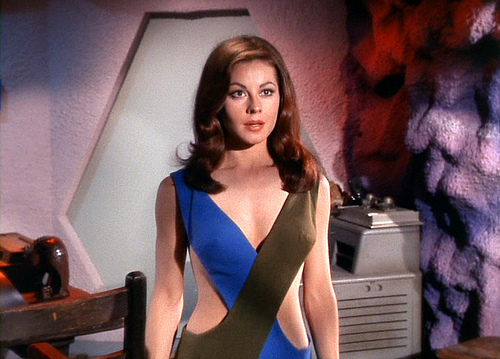
It is very strange watching young Sherry Jackson here at 12 years old, as I know her best as the sexy android Andrea from Star Trek.
 Image result for sherry jackson star trek

Jean Hagen was ultimately unhappy doing the series, and at the end of her three-year contract she wanted out. With her gone, the series was retooled and re-titled The Danny Thomas Show. You will find the series referred to under both names for its whole run. To explain the disappearance of Hagen, rather than simply recast the role of Margaret and to avoid the issue of divorce, the series killed her off and Danny was now a widower. I'm not certain, but this may have been the first time this was done on television, setting precedent for other series to follow (most recently, Kevin Can Wait). Ratings declined during season four with single dad Danny, but the season ended with a story arc that introduced Kathy, played by Marjorie Lord, a new love interest for the character, and she and Danny got engaged.

At this point, ABC cancelled the show. But with I Love Lucy reaching its end,  The Danny Thomas Show was picked up by CBS, now with Marjorie Lord as the wife, where it ran for another 7 years. It is these CBS years of The Danny Thomas Show, though often still called Make Room For Daddy, that are in frequent syndication, DVD box sets, and streaming. If you've seen the show in reruns, odds are it was one of the CBS episodes. The Jean Hagen years are all but swept under the rug, which is something of a shame. Sherry Jackson also left when her contract was up, and her role was eventually recast.

Now that we've gotten all of that complicated stuff out of the way, you can see why it was difficult for me to find and watch these episodes. When you think you've found episodes of season 2, they end up actually being season 6. The later years of the series were successful in their own right, with several crossovers with other popular sitcoms, and went on to spin off The Andy Griffith Show. Did you know that was a spin-off? But I want to focus on the shows that I watched, the ones that earned the Emmy.

The series had actually already won an Emmy for its debut season, for Best New Series (a category they seem to have since done away with). So it was not exactly a surprise for this to be the show that would take the crown back from I Love Lucy in its next year. As I had no background with the series, the first episode of season 2 is a little jarring. The story is of Danny in a funk, thinking he's a lousy performer, and taking it out on the family. I have to say, it was weird sitting down to watch this happy family sitcom about a father, and having his first appearance be surly and snapping at his kids! It's a good show ultimately, but not a good start to the season.

The humor is simple and wholesome as you would expect. If you've any watched family sitcoms in the last 50 years, you basically know what you are getting. The kids say cute things and get into trouble, the dad is a larger-than-life personality, the mom struggles to keep it all together with grace. It's a little safe, but it was pioneering the genre. There are episodes and stories in this season that would be constantly reused decade after decade on other shows. In fact, several of these early episodes would be redone in the later CBS seasons. Watching a show like "Rusty Gets a Haircut" I was immediately reminded of an episode of Full House. A daughter's first crush, a tonsillectomy, a two-parter about the promise of a new job, these are all now typical sitcom stories. But let's give a nod to Make Room For Daddy for digging that well.

There are a few supporting players in the cast, such as Danny's agent. The family also has a black housekeeper, though she appears very sporadically. I saw her in one episode, and then never again in the six that I watched.

There is what I assume was a two-part story (though I only got to see the second half) that follows Danny getting the opportunity to go to Hollywood and be in a movie. The family is excited for the opportunity and plans to buy new house, but things change when the producer of the film wants Danny to get a nose job. Ultimately he chooses to be himself rather than undergo surgery just for the fame. Apparently this storyline was based on something that actually happened to Danny Thomas. It was a rather moving episode.

Overall, I liked the cast and found the show relatively amusing. I would have liked to see more, and I am frustrated that these formative years are so difficult to see. But if you are in the mood and are interested, look them up on YouTube. Many are even complete with their original vintage commercials!

FAVORITE EPISODE: Hollywood Trip
UP NEXT: The Phil Silvers Show

Thursday, February 21, 2019

EMMYS 1954: I Love Lucy (season 3)

Yes, the popular sitcom won the Emmy for best situation comedy for the second year in a row.

There's still a lot to love about the show going into its third season. By this point, the Ricardos are America's favorite family and that fame is commented on in a few ways. After Life magazine did a spread on Lucy and Desi, the Ricardos got a similar story done about them. And they used a real issue of Life onscreen, though of course the Ricardo story was a fake inserted by the prop department. Also of note, the back cover of that particular issue was a full-page ad for Lucky Strike cigarettes. The show was forced to do a fake back cover by the sponsor, Phillip Morris. Can't advertise the competition onscreen!

The Ricardos also now have a baby, and the series does a decent job juggling stories that do and don't involve parenthood (they conveniently have a neighbor to watch the baby whenever the plot calls for it). But of course this show was filmed pretty quickly without many reshoots and it's clear the twins playing Little Ricky do not like it! No Olson Twins, here; Little Ricky spends a lot of his screen time crying.

What I do want to single out in this season though is the music. Wilbur Hatch provides an awful lot of great incidental music. Of course, the series has always had good music in the club with Ricky's performances. The musicians in the club are great and Desi's a good performer. But there is a lot of incidental music in the series as well. We forget how much music there was in older television. Modern sitcoms might have a theme song and a guitar riff for scene transitions and that's it. But there is full orchestral score for I Love Lucy episodes. The best example of this is the dream pantomime sequence in "Ricky's New Girlfriend". The music is telling the story there, in a method very similar to what was popular in musical theater around that time.

One of my favorite moments of the season and perhaps the series was Ricky telling the story of Little Red Riding Hood in Spanglish to Little Ricky. It's hilarious. Worth noting as well if you look closely you'll see that in Little Ricky's crib he has a pillow or blanket with the cartoon images of Lucy and Desi from the opening title sequence.

As with last season, the show keeps seeking new ways to stay fresh. They had a few more celebrity guest stars. This included up-and-coming entertainer Tennessee Ernie Ford as Lucy's cousin (not actual relation, but it's complicated). He stays for a multi-episode arc. Is this the first two-parter in sitcoms? It also reminds me of a story arc on Friends which also featured a horrible roommate named Eddie who wouldn't leave. There was also an episode about redecorating the Mertz's apartment, which ultimately led to the Ricardos buying new furniture (again!). It seemed clear to me that this redecorating tactic was starting to wear itself out and they would have to look to other ways of shaking the show up. At the end of the season, we are teased with that possibility: the cast going on vacation and subleasing their apartment in the meantime. Later seasons will take the family on road trips and ultimately they will move out of that apartment for good. For a series that only ran 6 seasons (before morphing into a short-lived spin-off which is often counted as the later seasons of the show), they never stayed in the same set too long. Long-running sitcoms don't always seem to have this much shake-up in the environments today, but there seemed to be a concerted effort here to keep things different.

For all the good in this season, I don't think it is as strong as season 2 was. It's starting to feel its age, and the addition of the baby both helps and hurts it. There are still very good episodes and funny moments, but fewer outright classic ones. There are things that date the show a bit. I particularly noticed how often Lucy responds to Ricky with, "Yes, sir." Can you imagine that flying today without angry protests? But there are also some hilarious moments like the entire "Equal Rights" episode that I think in some ways still hold up. The girls object that women are treated the same as men, so Fred and Ricky agree to treat them the same as men for a lark. The women almost immediately are put off by the things they expect to be done for them (getting their coats, pulling out chairs, letting them order first), the preferential elements of society, are gone. It's a good conversation starter.

Though worth noting, during this season they re-broadcast "Lucy Does a TV Commercial", and not with the flashback structure employed in season 2. That probably makes this the first true re-run.

FAVORITE EPISODES: Ricky's Life Story, Equal Rights, Lucy Tells the Truth,  Too Many Crooks, Ricky Minds the Baby, Sentimental Anniversary, Home Movies, The Black Wig

UP NEXT: Make Room For Daddy